Develop a wide-ranging and comprehensive skill set in effective cyber security measures, threats and technologies on our fully certified course*.
Year of entry: 2024 (September)
Join us online or in person to find out more about postgraduate study at York.
Upcoming eventsSecurity of our systems is one of the most challenging topics of our time. There is an international consensus that in order to respond to the number and sophistication of threats that we face, the level of security skills we have needs to be increased.
This forward-looking, fully certified course will give you the skills and knowledge you need in the core areas of cyber security. You'll learn the theories, principles, practices and technologies of cyber security and gain knowledge and understanding of the principles underpinning effective approaches to cyber defence.
The course emphasises important technical material that will help you make effective cyber security decisions, and addresses issues such as: identity; trust and reputation; cryptography; network security; malware and intrusion detection; risk management; and the development of high-assurance systems.
If you are interested in pursuing a career in industry or government, this course will provide you with a broad education in cyber security, which will allow you to make technically informed principled decisions.
This course will also prepare you if you are seeking a research career in cyber security; a research skills module is a mandatory part of the course.
This is one of the few cyber security Masters degrees in the UK that is fully certified by the National Cyber Security Centre (NCSC).
Find out more about what this professional accreditation means.
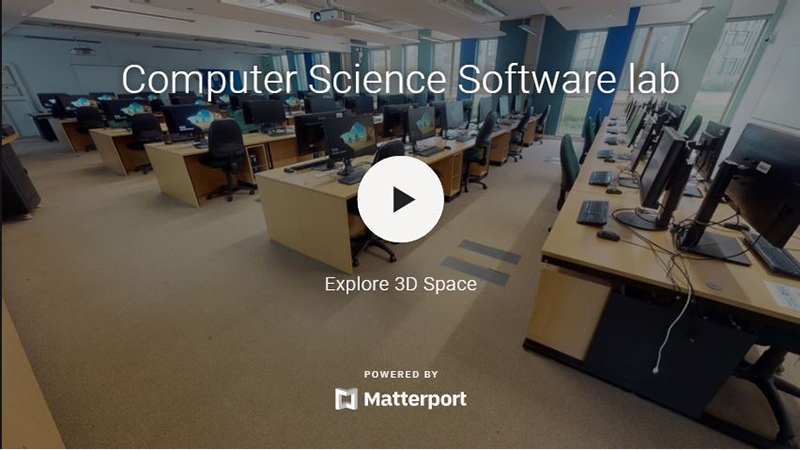
Our software labs offer 24/7 access for individual and group work.
Our staff are at the cutting edge of their fields and we maintain strong links with industry.
The first half of the course is taken up by taught modules. Modules comprise a mix of lectures, problem classes and practical classes, plus personal study time. In the second half of the course, you will undertake an individual research project under the supervision of a member of staff.
Our modules may change to reflect the latest academic thinking and expertise of our staff.
As part of this course you will undertake an individual project and dissertation. This takes place over the summer and is supervised by a member of academic staff. It may involve working with an external organisation. You will be encouraged to work with academic staff to create projects which are of specific interest to you and the staff member you are working with.
You will be given considerable flexibility in the topics you can choose to base your project around, providing academic criteria are met. To ensure you reach your goals, your project will be assessed at an early stage to ensure that it is suitable for study at this level. Many previous projects undertaken have followed naturally from the taught material. However, your project may also investigate suitably challenging topics outside that material if you wish.
At the end of this period of study you will be asked to produce a dissertation describing your project work.
Every course at York is built on a distinctive set of learning outcomes. These will give you a clear understanding of what you will be able to accomplish at the end of the course and help you explain what you can offer employers. Our academics identify the knowledge, skills, and experiences you'll need upon graduation and then design the course to get you there.
| Study mode | UK (home) | International and EU |
|---|---|---|
| Full-time (1 year) | £12,480 | £29,400 |
Students on a Student Visa are not currently permitted to study part-time at York.
UK (home) or international fees? The level of fee that you will be asked to pay depends on whether you're classed as a UK (home) or international student. Check your fee status.
Find out more information about tuition fees and how to pay them.
There are unlikely to be any mandatory additional costs associated with the course, although you may want to set aside £200 for optional photocopying and personal stationery over the duration of the course.
Discover your funding options to help with tuition fees and living costs.
We'll confirm more funding opportunities for students joining us in 2024/25 throughout the year.
If you've successfully completed an undergraduate degree at York you could be eligible for a 10% Masters fee discount.
You can use our living costs guide to help plan your budget. It covers additional costs that are not included in your tuition fee such as expenses for accommodation and study materials.
You’ll work with world‐leading academics who’ll challenge you to think independently and excel in all that you do. Our approach to teaching will provide you with the knowledge, opportunities, and support you need to grow and succeed in a global workplace.
Part of this course is taken up by taught modules. Each module comprises a mix of lectures, problem classes and practical classes, plus personal study time. You should expect to be working on open assessments during vacation periods. Throughout the course you will have a personal tutor, who will provide academic and pastoral advice.
In the second half of the course, you'll undertake an individual research project under the supervision of a member of staff. When you undertake your individual project, you will be allocated a supervisor within your area of interest. Work on your individual project will start around the beginning of April, and you will receive regular one-to-one supervisions throughout your project. You will continue to work on your individual project over the summer, and there will be continuing supervision and research-group meetings to discuss your project. You will finish the course when you hand in your dissertation and paper for your project in September.
Due to the intensive nature of the course, you will need to be in York throughout both semesters and over the summer while you undertake your individual project.
Built to the highest specifications, the department is packed with cutting-edge facilities housed in a modern, self-contained building.
The department houses four software labs and two hardware labs. One of the hardware labs is equipped with dedicated Cyber Lab infrastructure required for several of your practical classes.
Our Interaction Labs provide excellent facilities for research and teaching in human-computer interaction. The Interaction Labs consist of an Accessibility and Usability Lab and a Games Research Lab, both of which are stocked with the latest technologies.
Our Real Time Systems Lab is the main research and development facility for the Real Time Systems research group. Inside the lab is a range of high-performance computers, custom hardware like FPGAs, robots, and various industrial machinery.
The Computer Vision group have a darkroom laboratory which enables us to conduct experiments in controlled illumination conditions and a second laboratory which includes a commercial 3D scanner.
Our Robotics Laboratory is a purpose-built laboratory used for various robotics research projects and teaching. Within it, there is a dedicated student working area, with workstations and electronics bench equipment, alongside the main 80m2 robotics arena. The arena features a 5.5m high ceiling allowing drone experiments to take place alongside ground-based robots. Special tracking systems are installed to allow positional data of the robots to be extracted. There is also a workshop area with CAD, soldering and 3D printing facilities.
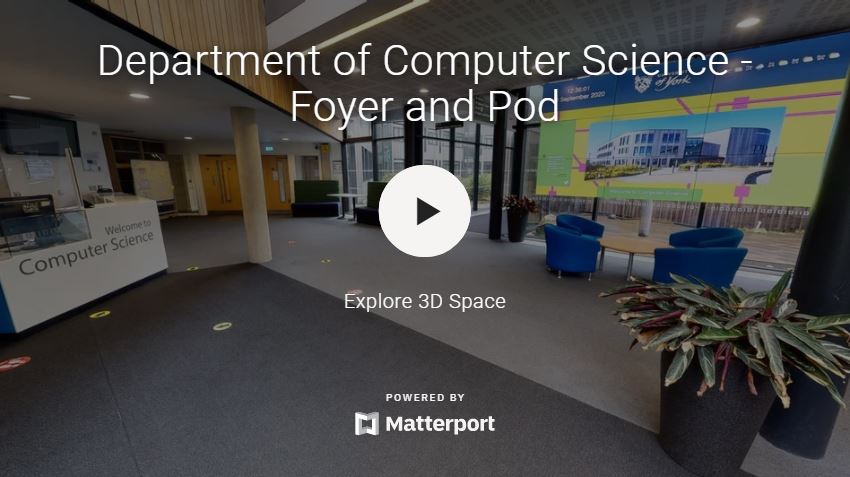
Find out more about our facilities, including a video tour showing our labs, teaching and research spaces.
Computer Science is based on Campus East. The majority of teaching on this course takes place on Campus East in the Computer Science building and Ron Cooke Hub.
Our beautiful green campus offers a student-friendly setting in which to live and study, within easy reach of the action in the city centre. It's easy to get around campus - everything is within walking or pedalling distance, or you can always use the fast and frequent bus service.
All taught modules on this course are examined by open assessments. This type of assessment allows you to engage with the research literature and gives us the chance to assess your practical skills.
Once you have successfully completed the taught modules, you will undertake an extensive individual project. Here you will work on an identified cyber security topic, and document the results in a report.
Assessments will take place at various times during the year. Practical exercises, reports and other forms of open assessment will be due either during the course module or just after its completion.


Take a virtual tour of one or our modern, dedicated facilities.

This course will prepare you for a career in the field of cyber security. It will also equip you with the relevant skills to undertake further research in the area.
Previous graduates have gone on to technical roles, such as malware analysis, security design, penetration testing and broader roles such as risk assessment, security planning, or security consultancy. Some previous students have returned to their home countries to teach security, and others have gone on to study for a PhD.
| Typical offer | |
|---|---|
| Undergraduate degree | 2:1 or equivalent in Computer Science or a related discipline. Successful applicants will demonstrate a strong background in the following essential criteria: Discrete Mathematics, Software Engineering, Networks, Programming, and a knowledge of basic algorithms. |
| Other qualifications and experience | We are willing to consider your application if you do not fit this profile, providing you are able to demonstrate that you have the required amount of Computer Science knowledge and experience to succeed on the programme. |
| Other international qualifications | Equivalent qualifications from your country |
If English isn't your first language you may need to provide evidence of your English language ability. We accept the following qualifications:
| Minimum requirement | |
|---|---|
| IELTS (Academic and Indicator) | 6.5, minimum 6.0 in each component |
| Cambridge CEFR | B2 First: 176, with 169 in each component |
| Oxford ELLT | 7, minimum of 6 in each component |
| Duolingo | 120, minimum 105 in all other components |
| LanguageCert SELT | B2 with 33/50 in each component |
| LanguageCert Academic | 70 with a minimum of 65 in each component |
| KITE | 459-494, with 426-458 in all other components |
| Skills for English | B2: Merit overall, with Pass with Merit in each component |
| PTE Academic | 61, minimum 55 in each component |
| TOEFL | 87, minimum 21 in each component |
| Trinity ISE III | Merit in all requirements |
For more information see our postgraduate English language requirements.
You may be eligible for one of our pre-sessional English language courses. These courses will provide you with the level of English needed to meet the conditions of your offer.
The length of course you need to take depends on your current English language test scores and how much you need to improve to reach our English language requirements.
After you've accepted your offer to study at York, we'll confirm which pre-sessional course you should apply to via You@York.

We offer a range of campus accommodation to suit you and your budget, from economy to premium.

Explore campus and city life and hear what our current students have to say about living here.

Lively, full of culture and beautiful, York is regularly voted one of the best places to live and visit in the UK.

Find out more about York. Chat to staff and students and take the tour, on campus or online.