Understand the core aspects of how complex products and services undertake tasks that pose a risk to human lives, and become a practitioner in keeping people safe.
Year of entry: 2024 (September)
Join us online or in person to find out more about postgraduate study at York.
Upcoming eventsThis course will provide you with the educational background required to become a leader in the field of safety critical systems engineering, whether you are currently a practising - or aspiring - professional in this area.
Products and services are taking on more authority over activities that have the capability to pose a risk to human lives. System safety professionals address a web of interlinked contributing factors to assess the safety of these products or services.
This course will provide you with the opportunity to become a practitioner, or enhance your existing practice, in the core aspects of safety-critical systems engineering and to reflect on the implications of your work both for your current role and for society as a whole. Three strands of work will develop your skills: system safety thinking, skills as a safety engineer and professionalism.
The course will enable you to become better equipped to make a contribution to your organisation. We will provide you with an initial grounding and practical experience in the use of techniques for the development and assurance of the safety characteristics of systems or services that have safety implications. You will explore the principles behind these techniques so that you can make sound safety engineering judgments. You'll also have the opportunity to investigate the latest research.
The course employs the extensive research and industrial experience of the developers of the work packages you will address. It brings together safety professionals from many different domains (aerospace, military, automotive, railway, nuclear) to ensure your learning is as varied and as comprehensive as possible.
This course is also available as an MSc in Safety Critical Systems Engineering or a PGDip in Safety Critical Systems Engineering.
Our staff are at the cutting edge of their fields and we maintain strong links with industry.
The course is taken on a part-time basis over either one or two years. This means it is very flexible and can easily fit in around work commitments.
Modules are delivered through set teaching weeks and you will be required to attend campus for some face-to-face teaching during teaching weeks. You'll undertake intensive teaching sessions based on lectures, case-studies and exercises. Additionally, for each module, you will need to undertake some self-study before and after face-to-face teaching.
Topics covered by taught modules may include:
Our modules may change to reflect the latest academic thinking and expertise of our staff.
Our modules may change to reflect the latest academic thinking and expertise of our staff.
Every course at York is built on a distinctive set of learning outcomes. These will give you a clear understanding of what you will be able to accomplish at the end of the course and help you explain what you can offer employers. Our academics identify the knowledge, skills, and experiences you'll need upon graduation and then design the course to get you there.
| Study mode | UK (home) | International and EU |
|---|---|---|
| Part-time (2 years) This is the year 1 fee. Fees for future years are subject to confirmation. |
£5,980 | £7,350 |
| Part-time (1 year) | £11,960 | £14,700 |
Students on a Student Visa are not currently permitted to study part-time at York.
For courses which are longer than one year, the tuition fees quoted are for the first year of study.
Text books and resources will be available to you through the University of York library and electronic copies of all course materials are provided. You will need to arrange and pay for your own accommodation and travel to York for face-to-face teaching. Costs associated with this will vary depending on your location and the standard of accommodation you book.
You can use our living costs guide to help plan your budget. It covers additional costs that are not included in your tuition fee such as expenses for accommodation and study materials.
You’ll work with world‐leading academics who’ll challenge you to think independently and excel in all that you do. Our approach to teaching will provide you with the knowledge, opportunities, and support you need to grow and succeed in a global workplace.
The course is delivered by taught modules that include an intensive, York-based face-to-face element. Teaching methods include lectures and seminars, interspersed with case study exercises which take place in groups of 6-8 students. For most modules, pre-recorded materials for private study will also be provided. After the York-based taught element, students are expected to complete an open assessment for each module.
The Department of Computer Science is based on Campus East. Teaching takes place in a range of locations on Campus East.
Our beautiful green campus offers a student-friendly setting in which to live and study, within easy reach of the action in the city centre. It's easy to get around campus - everything is within walking or pedalling distance, or you can always use the fast and frequent bus service.
Each module has an associated open assessment.
This means that you undertake the assessment in your own time away from the University following the taught element of the module. This open assessment, and any associated work packages, is designed to consolidate and further deepen your knowledge, skills and approaches to the subject matter covered in the module. Of course, it is also designed to assess your progress."


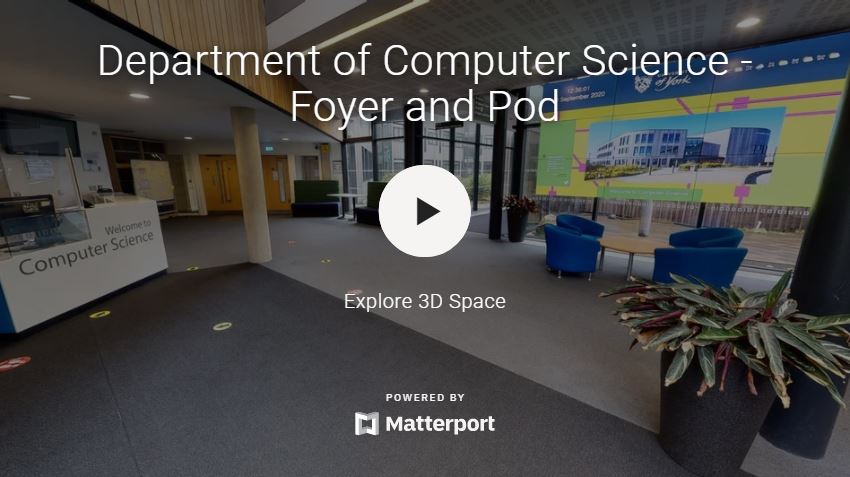
Take a virtual tour of one or our modern, dedicated facilities.
The vast majority of people who undertake this course are already working in industrial fields such as aeronautical engineering, marine engineering, naval and military fields, automotive applications, gas and electric services engineers. Undertaking this course will equip you to progress within these fields.
| Typical offer | |
|---|---|
| Undergraduate degree | 2:2 or equivalent in a numerate, technical discipline. This course is specifically directed at those with several years of industrial experience. |
| Other qualifications and experience | If you do not have a first degree but instead have relevant industrial experience, your application will be considered on a case by case basis. |
| Other international qualifications | Equivalent qualifications from your country |
If English isn't your first language you may need to provide evidence of your English language ability. We accept the following qualifications:
| Minimum requirement | |
|---|---|
| IELTS (Academic and Indicator) | 6.5, minimum 6.0 in each component |
| Cambridge CEFR | B2 First: 176, with 169 in each component |
| Oxford ELLT | 7, minimum of 6 in each component |
| Duolingo | 120, minimum 105 in all other components |
| LanguageCert SELT | B2 with 33/50 in each component |
| LanguageCert Academic | 70 with a minimum of 65 in each component |
| KITE | 459-494, with 426-458 in all other components |
| Skills for English | B2: Merit overall, with Pass with Merit in each component |
| PTE Academic | 61, minimum 55 in each component |
| TOEFL | 87, minimum 21 in each component |
| Trinity ISE III | Merit in all requirements |
For more information see our postgraduate English language requirements.
You may be eligible for one of our pre-sessional English language courses. These courses will provide you with the level of English needed to meet the conditions of your offer.
The length of course you need to take depends on your current English language test scores and how much you need to improve to reach our English language requirements.
After you've accepted your offer to study at York, we'll confirm which pre-sessional course you should apply to via You@York.

We offer a range of campus accommodation to suit you and your budget, from economy to premium.

Explore campus and city life and hear what our current students have to say about living here.

Lively, full of culture and beautiful, York is regularly voted one of the best places to live and visit in the UK.

Find out more about York. Chat to staff and students and take the tour, on campus or online.